The Neuroscience of Belief: How to Literally Rewire Your Brain’s Code
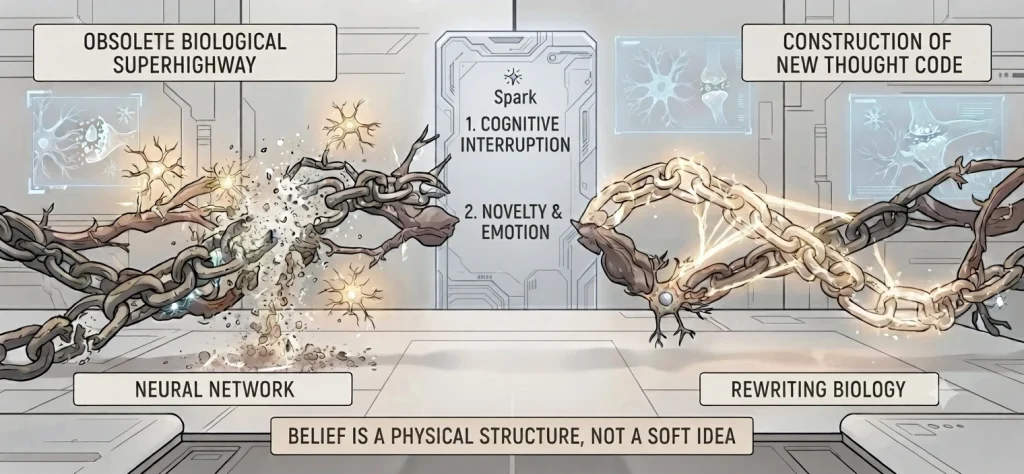
Your mind does not operate on soft, intangible ideas. Every belief you hold—whether it is “I am capable of achieving my goals” or “I always fail when things get tough”—is a physical, biological structure inside your head. Beliefs are made of meat and electricity. They are microscopic networks carved into your brain tissue.
When you try to change a deeply ingrained belief, you are not just changing your mind. You are attempting a complex engineering project: dismantling an established biological superhighway and building a new one from scratch.
Here is the exact neuroscience of how your brain encodes beliefs, why it fiercely resists changing them, and how you can use neuroplasticity to literally rewrite your mental code.
1. The Architecture of Mind Code: How a Belief is Formed
To understand how to change your brain, you must first understand how it builds a belief. Your brain contains roughly 86 billion neurons. These neurons communicate through electrical impulses and chemical signals across gaps called synapses.
[Trigger / Event] ──> [Active Neuron A] ──(Synapse)──> [Active Neuron B] ──> [Automatic Response] ▲ │ (Repeated Action / Strong Emotion) └─── Myelin Sheath Thickens (Faster Signal)
When you experience something for the first time, a specific cluster of neurons fires. If that experience repeats, or if it is accompanied by a strong emotional charge, those same neurons fire together again.
This process is governed by Hebbin Learning Rule, a fundamental principle in neuroscience formulated by Donald Hebb in 1949:
“Neurons that fire together, wire together.”
When neurons fire together repeatedly, several physical changes occur:
- Synaptic Strengthening: The connection between the neurons becomes more sensitive.
- Myelination: The brain wraps the neural pathway in a fatty protective coating called myelin. Myelin acts like insulation on an electrical wire, allowing signals to travel up to 100 times faster.
Once a pathway is heavily myelinated, it becomes the path of least resistance. The brain no longer needs to think; it automates the response. This automated neural highway is what we call a core belief. If your childhood taught you that vulnerability leads to pain, your brain built a highly myelinated highway connecting “vulnerability” to “danger.”
2. Neuroplasticity: The Brain’s Ability to Delete and Rewrite Code
For decades, the scientific consensus was that the adult brain was fixed. It was believed that once you reached your mid-20s, your neural pathways were set in stone.
Modern neuroscience has completely debunked this myth.
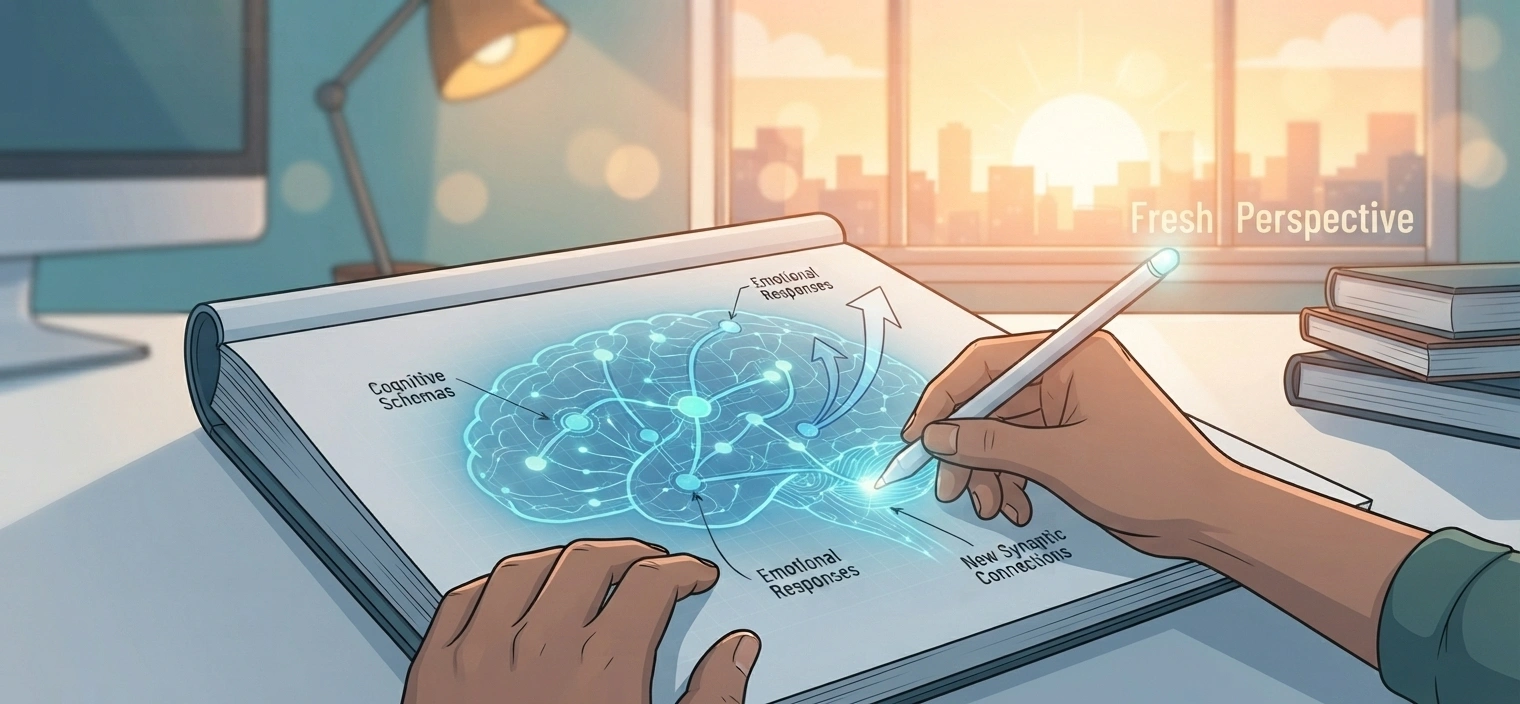
Through neuroplasticity (brain plasticity), your brain retains the ability to alter its physical structure and functional organization throughout your entire life. It can grow new neurons (neurogenesis), strengthen existing connections, and critically, dismantle old ones.
The mechanism behind deleting old beliefs is called synaptic pruning.
[ Old Unused Pathway ] [ New Active Pathway ]
○ ── ─ ─ ──> ○ ● ━━━━━━━━━━━> ●
(Signal stops firing) (Repeated conscious effort)
│ │
▼ ▼
Brain cuts connection Pathway gets stronger
(“Synaptic Pruning”) (“Hebbian Wiring”)
Your brain is a highly metabolic organ; it consumes roughly 20% of your body’s energy. It cannot afford to waste energy maintaining neural pathways that are never used. When you actively stop using an old mental loop, the brain flags that pathway as obsolete. Over time, microglia (the brain’s cleanup crew) physically dismantle those unused synaptic connections.
Why Changing Beliefs Feels Physically Uncomfortable
If the brain is plastic, why is changing a belief so incredibly difficult? The answer lies in the amygdala—the brain’s threat detector.
Your brain values predictability over happiness. An old, negative belief is predictable; the brain knows how to navigate it. When you try to adopt a radically new belief, the prefrontal cortex (the thinking brain) goes against the established, myelinated highway.
The amygdala perceives this unfamiliar neural activity as a glitch or a threat to your survival. It triggers a mild fight-or-flight response. This is why stepping out of your comfort zone or challenging your self-identity causes physical anxiety, doubt, and discomfort. It is not a sign that you are failing; it is biological proof that you are overriding your old code.

3. The 3-Step Scientific Framework to Rewire Your Brain
To successfully overwrite a core belief, you cannot rely on passive wishful thinking. You must follow a structured process that forces neuroplasticity to occur.
Step 1: Cognitive Interruption (Isolate the Defective Code)
You cannot prune a pathway if you do not know it is firing. Most core beliefs run as background processes. You must use your prefrontal cortex to practice metacognition—the act of thinking about your thinking.
When you feel a sudden drop in mood, anxiety, or self-doubt, pause immediately. Intercept the thought.
- Old automatic pathway: “I can’t present this project, I’m terrible at public speaking.”
- The Interruption: “My amygdala is firing an old, automated script based on past data. This thought is a neural pathway, not an absolute fact.”
By naming the process, you shift the brain activity away from the emotional amygdala and into the logical prefrontal cortex, halting the automatic signal.
Step 2: Introduce Novelty and Emotional Charge
The brain does not change its structure for boring data. It requires a chemical catalyst to open the window of neuroplasticity. The most powerful catalysts are novelty and high emotion.
This is why traditional, repetitive affirmations often fail. If you look in the mirror and say “I am a millionaire” while feeling broke and miserable, your brain rejects the data because there is a massive mismatch between your words and your emotional chemistry.
To successfully introduce new code:
- Find evidence: Give your brain raw facts. If you want to believe “I am competent,” write down a concrete list of five things you have successfully executed in the past year.
- Elevate your emotional state: Visualize the new belief as true and intentionally cultivate the feelings of relief, pride, or safety that come with it. This emotional spike releases dopamine and acetylcholine, the exact neurotransmitters required to lock in new synaptic connections.
Step 3: High-Frequency Repetition (Consolidate the Code)
Neuroplasticity is a volume game. A single moment of insight will not destroy a 20-year-old neural highway. You must drive down the new mental path so frequently that the brain is forced to myelinate it.
Frequency of Thought ──> High Myelination ──> Automated Belief
Commit to daily cognitive restructuring. Every single time the old limitation pops up, consciously intercept it and run the new script. If you do this consistently, a tipping point occurs. The old pathway undergoes synaptic pruning, the new pathway becomes heavily myelinated, and the new belief becomes your new automatic default.
The Ultimate Biohack
Changing your beliefs is not a mystical process reserved for the lucky few. It is an algorithmic, biological reality. You are the programmer, and your neural pathways are the code.
By understanding the neuroscience of belief, you take the power out of your past traumas and limitations. You no longer have to wait for inspiration to strike. You simply need to interrupt the old code, emotionally anchor the new data, and repeat the process until biology takes over.
Try it for FREE and see how simple it is to rewire negative mindsets. All it takes is 20 minutes!

UP TO 97% OF BELIEFS IN A MONTH!
Transform your Limiting Beliefs using the BCS Online Service
A Simple and Effective Tool for self-reprogramming negative mindsets
I want to try it!