How to Reprogram Your Subconscious Mind: 5 Science-Backed Tools
Your conscious mind sets goals, plans for the future, and holds your willpower. It is the part of you that decides to start a diet, launch a business, or wake up early. Yet, behavioral psychologists and neuroscientists estimate that the subconscious mind drives up to 95 percent of your daily actions, decisions, and emotional reactions.
If you have ever tried to break a bad habit, eliminate a phobia, or force a massive lifestyle shift through sheer willpower alone, you have likely hit an invisible wall. You promised yourself you wouldn’t procrastinate, yet hours later, you found yourself trapped in the exact same loops. This friction occurs because lasting change does not happen by fighting your automatic patterns with conscious force; it happens by updating them at the root.
Effective cognitive shifts require moving beyond surface-level motivation and engaging with evidence-based strategies designed to systematically rewire your neural pathways. Here are 5 science-backed tools to help you reprogram your subconscious mind.
1. Cognitive Behavioral Therapy (CBT) Reframing and Cognitive Restructuring
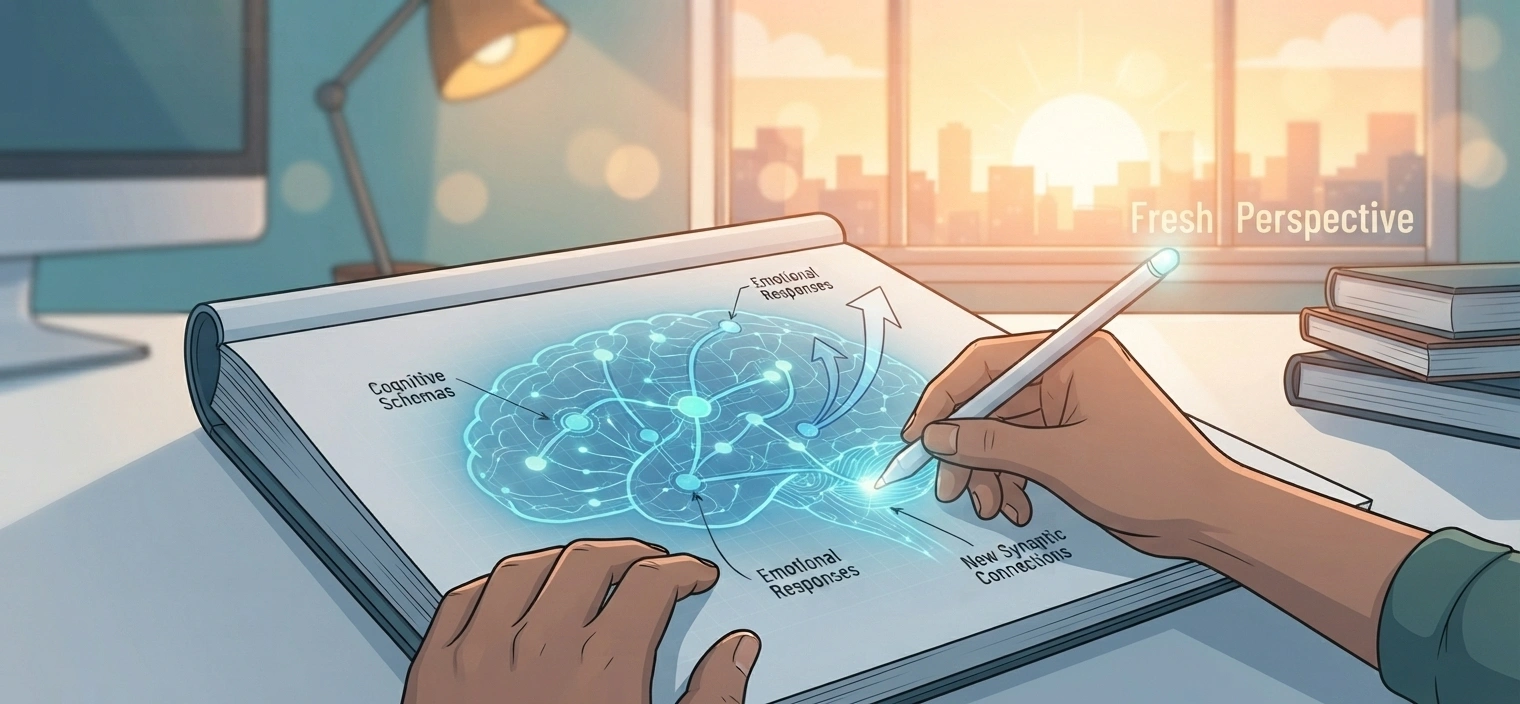
Cognitive Behavioral Therapy stands as one of the most thoroughly researched and validated frameworks in modern psychology for identifying and altering deep-seated mental models. Your subconscious often runs on automatic negative thoughts (ANTs) and cognitive distortions formed years or even decades ago in response to stress or trauma.
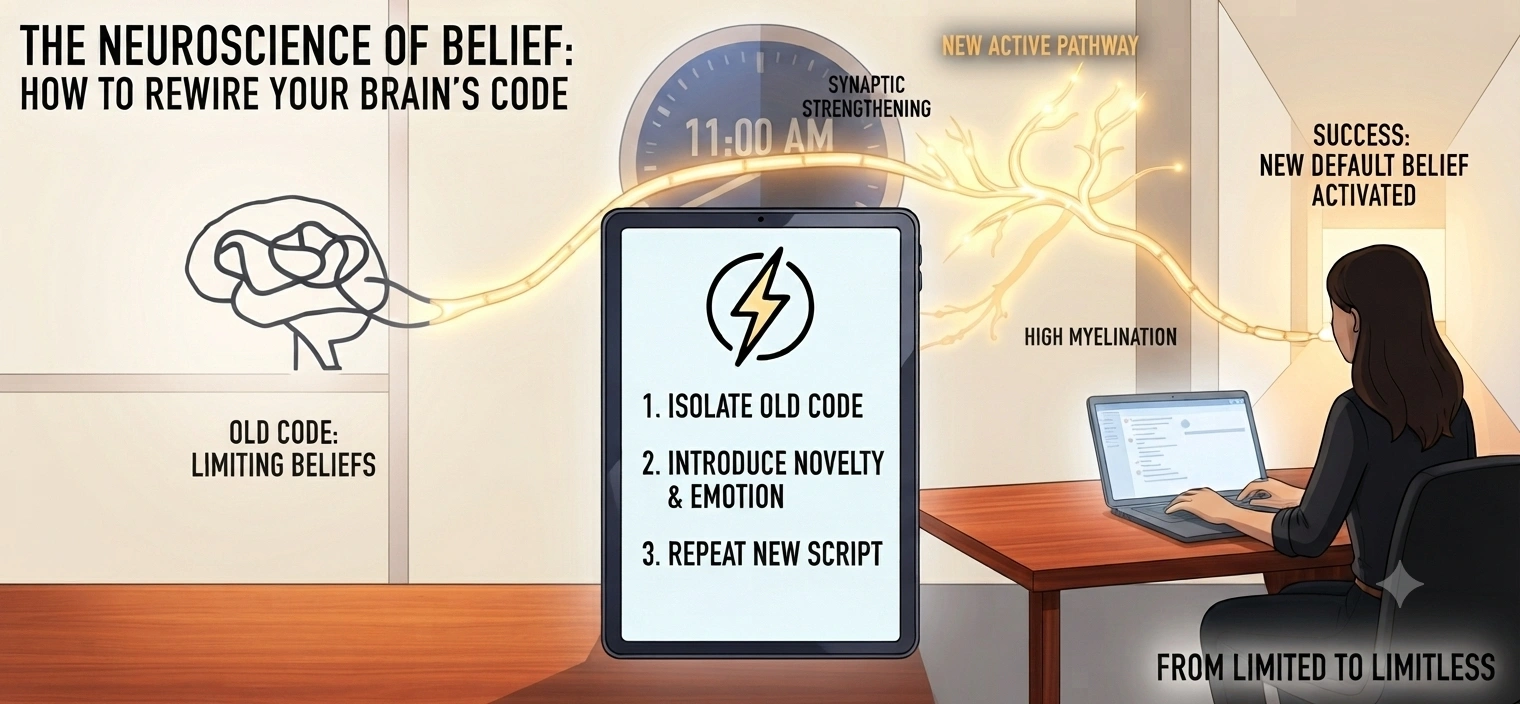
- The Mechanism: Neuroplasticity dictates that neurons that fire together, wire together. Decades of ingrained negative thinking have carved deep neural grooves in your brain. CBT teaches you to intercept these automatic thoughts in real time, examine the objective evidence behind them, and systematically replace them with constructive alternatives. Over time, this starves the old neural pathways of activation while reinforcing healthier cognitive routes.
- How to Apply It: Keep a detailed thought journal for at least two weeks. Whenever you experience a sudden emotional spike, anxiety, or a self-defeating urge, write down three columns: the triggering event, the automatic thought that immediately followed, and the underlying core belief driving it. Actively challenge that belief with hard logic to weaken its automatic hold over your behavior.
2. Neuroplastic Meditation and Targeted Visualization
Meditation is frequently misunderstood as a passive practice meant simply to “clear the mind” or induce relaxation. However, modern neuroscience reveals it is actually a powerful, active tool for structural brain remodeling.
- The Mechanism: Regular mindfulness and targeted visualization practices have been shown in fMRI studies to physically thicken the prefrontal cortex—the seat of executive function—while reducing the size and reactivity of the amygdala, your brain’s fear and stress center. Furthermore, neuroscientific research demonstrates that vividly simulating a desired behavior or future state in a deeply relaxed, meditative trance activates many of the exact same motor and emotional neural networks as actual physical practice. Your subconscious has difficulty distinguishing between a vividly imagined experience and reality.
- How to Apply It: Dedicate 10 to 15 minutes each morning to neuroplastic visualization. Close your eyes, slow your breathing to trigger parasympathetic nervous system dominance, and mentally rehearse executing a specific behavior or handling a challenging scenario with absolute calm and confidence. Make the mental movie as sensory-rich as possible.
3. Biofeedback and Neurofeedback Systems
Biofeedback bridges the gap between conscious control and autonomic nervous system regulation by leveraging advanced technology to monitor physiological markers in real time.
- The Mechanism: Your subconscious controls vital involuntary functions—heart rate, muscle tension, and brainwave states. When you experience stress, your body reacts automatically before your conscious mind registers the threat. Biofeedback sensors track metrics like heart rate variability (HRV), skin conductance, and EEG brainwave activity. By receiving instant visual or auditory feedback when your body enters a dysregulated state, you train your mind-body connection to consciously shift your physiological baseline back to coherence.
- How to Apply It: Work with a clinical practitioner or invest in consumer-grade wearable devices that track HRV and autonomic arousal. Practice coherence breathing (such as box breathing or resonant frequency breathing) while monitoring your biometric data. Training your nervous system to stay calm under physiological pressure rewires your subconscious stress response from the bottom up.

4. Habit Stacking and Behavioral Anchors
The subconscious mind is fundamentally an efficiency engine designed to conserve metabolic energy by automating repetitive tasks. Creating entirely new behavioral loops from scratch requires massive conscious mental energy, which is why people burn out on new goals so quickly. Habit stacking bypasses this resistance.
- The Mechanism: Pioneered by behavioral researchers, this technique pairs a brand-new desired habit with an existing, deeply ingrained subconscious routine. Because the old habit already possesses a fully myelinated, frictionless neural pathway, it acts as a launching pad for the new behavior.
- How to Apply It: Utilize the proven implementation formula: After [Current Habit], I will [New Habit]. For instance: “After I pour my morning cup of coffee, I will immediately write down the three core priorities for my workday.” By anchoring the new action to an established psychological trigger, you eliminate the decision fatigue that usually stalls subconscious reprogramming.
5. Automated Reprogramming and Digital Interventions
While mental exercises, meditation, and therapy are vital, consistency remains the ultimate bottleneck of personal transformation. Human memory is fallible, motivation fluctuates daily, and old patterns easily creep back the moment life gets stressful. This is where modern software, digital environments, and automation bridge the gap.
- The Mechanism: Automation removes human friction, forgetfulness, and willpower from the equation. By programming digital environments, automated reminders, behavioral prompts, and structured micro-steps directly into your daily routine, you force consistent exposure to new mental cues. Instead of relying on your conscious mind to remember to change, your system does the heavy lifting for you.
- How to Apply It: Integrating automated tools and digital frameworks into your growth strategy represents the absolute fastest path to systemic change. When your environment automates the prompts for your new behaviors, your subconscious adapts on autopilot, accelerating your personal transformation exponentially.
Moving From Insight to Automation
Understanding how to reprogram your subconscious mind is only the first step; true, permanent transformation requires seamless, daily reinforcement. While meditation, CBT, and biofeedback lay the critical groundwork, relying entirely on manual, analog effort significantly slows down your progress and leaves room for relapse.
Combining these science-backed internal exercises with a dedicated automation system ensures your new mental patterns lock in permanently, requiring a fraction of the traditional willpower.
Try it for FREE and see how simple it is to rewire negative mindsets. All it takes is 20 minutes!

UP TO 97% OF BELIEFS IN A MONTH!
Transform your Limiting Beliefs using the BCS Online Service
A Simple and Effective Tool for self-reprogramming negative mindsets
I want to try it!