How Long Does It Take to Change a Core Belief?
We’ve all been there: staring at a recurring pattern in our lives, wondering why we keep sabotaging our relationships, doubting our worth, or playing it safe despite desperately wanting change. You might read self-help books, repeat daily affirmations, or journal until your hand cramps, only to find yourself sliding right back into old mental loops.
The frustration usually births a heavy, exhausting question: Is this just who I am, or can I actually fix it? More specifically—how long does it take to change a core belief once and for all?
If you are looking for a neat 21-day or 30-day guarantee, modern psychology and neuroscience have some tough love for you. But they also offer profound, empowering hope.
What Exactly Is a Core Belief?
Before we talk about timelines, we need to look at what we are actually trying to dismantle.
Core beliefs are the deeply ingrained, absolute assumptions we hold about ourselves, other people, and the world. Formed primarily in childhood through repeated experiences, trauma, or cultural conditioning, they operate like the operating system running quietly in the background of your computer. You don’t consciously look at the OS every time you open a browser; you just see the screen.
Common negative core beliefs fall into a few rigid buckets:
- Helplessness: “I am incompetent,” “I am weak,” “I can’t handle things.”
- Unlovability: “I am unlovable,” “I am bound to be rejected,” “If people truly knew me, they would leave.”
- Worthlessness: “I am a failure,” “I don’t matter,” “I am inherently bad.”
Because these beliefs formed early as survival or coping mechanisms, the brain wired them into heavy, heavily myelinated neural pathways. They feel less like opinions and more like absolute, objective truths.
The Short Answer: What Science Says About the Timeline
Let’s address the elephant in the room. You will often see viral articles or pop-psychology blogs claim it takes 21 days to form or break a habit, based on a misinterpretation of plastic surgeon Maxwell Maltz’s 1960s observations on plastic surgery patients.
Real science tells a very different story about cognitive architecture.
According to behavioral research—most notably a landmark 2009 study by Dr. Phillippa Lally at University College London tracking habit formation—the actual time it takes for a new behavior to become automatic ranges anywhere from 18 to 254 days, with an average of 66 days for relatively simple habits.
When applied to core beliefs—which are structurally deeper than surface habits—the timeline stretches significantly. Clinical data from Cognitive Behavioral Therapy (CBT) and neuroplasticity research indicate that meaningful, structural shifts in deep-seated schemas typically require 3 to 6 months of consistent, active intervention, with deep-rooted trauma or complex PTSD often requiring 1 to 3 years of therapeutic work.
In short: You aren’t looking at a quick three-week fix. You are looking at a deliberate rewiring project.

The Neuroscience: Why It Takes Time to Rewire Your Brain
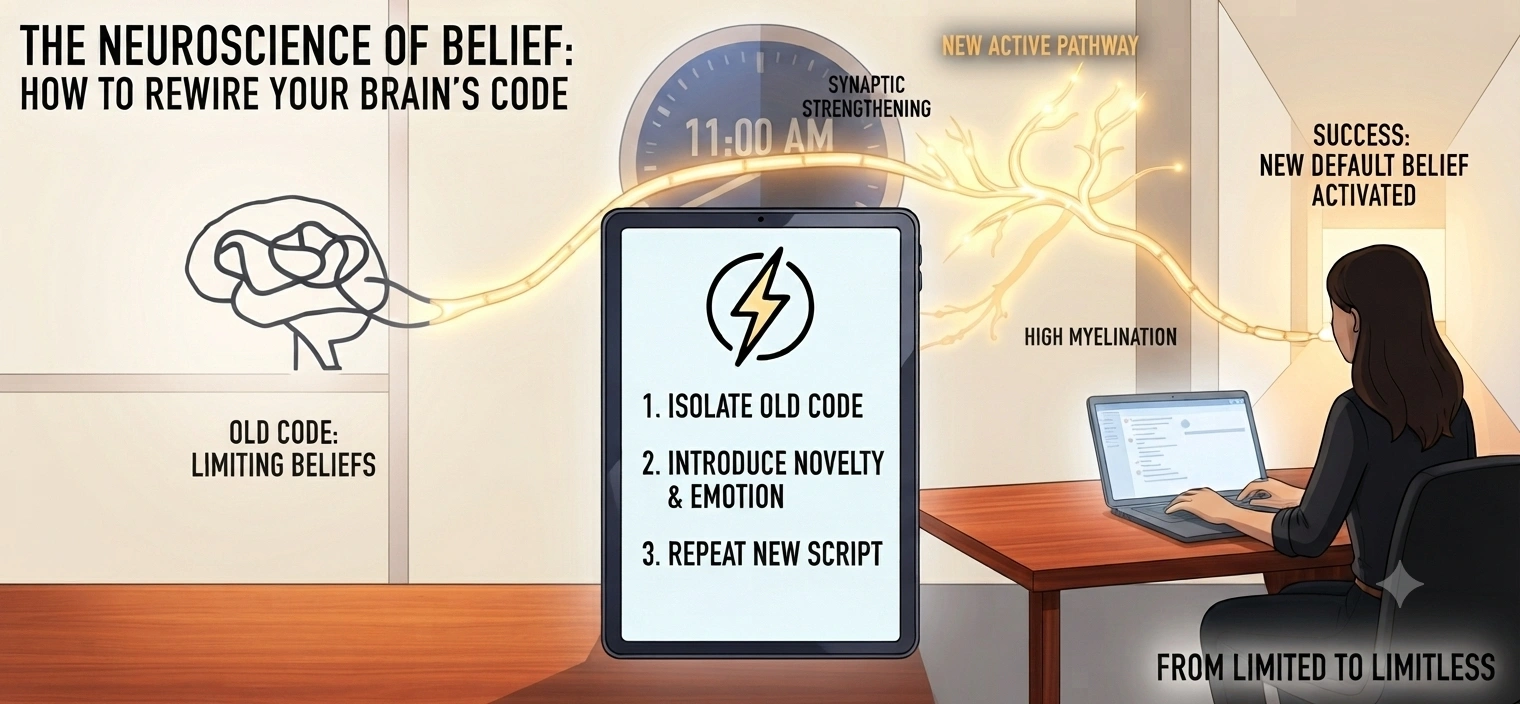
To understand why changing a core belief can’t happen overnight, you have to look at neuroplasticity—the brain’s ability to reorganize itself by forming new neural connections.
1. The Power of Hebbian Learning
In neuroscience, there is a famous phrase: “Neurons that fire together, wire together.” Every time you experienced an event in your past that reinforced a core belief (e.g., being laughed at when presenting in 4th grade), that neural pathway strengthened. Over decades, that pathway became a multi-lane superhighway.
2. The Energy Cost of Neurogenesis
Building a new belief means blazing a brand-new trail through a dense jungle. Your brain is biologically lazy—it prefers the low-energy, automated superhighway of your old beliefs, even if those beliefs are painful or self-defeating. Creating new neural pathways requires metabolic energy, focused attention, and emotional endurance.
3. The Role of the Amygdala
Your core beliefs act as your brain’s prediction engine. If your core belief is “I am bound to fail,” your amygdala scans the environment looking for confirmation to keep you safe from unexpected danger. When you try to adopt a new belief (“I am capable and resilient”), your nervous system often flags that unfamiliar territory as a threat, triggering resistance, anxiety, or self-sabotage.
The 4 Stages of Changing a Core Belief
You don’t just wake up one day with a brand-new worldview. Shifting a core belief is a developmental process that moves through distinct psychological phases:
[1. Awareness] ➔ [2. Deconstruction] ➔ [3. Reconstruction] ➔ [4. Consolidation]
Stage 1: Awareness (Catching the Filter)
You cannot change what you cannot see. In this stage, you begin to catch your core belief in real-time. Instead of just feeling depressed after a botched work presentation, you notice the inner voice whispering: “See? I always mess things up because I’m incompetent.”
- Timeframe: Weeks 1–4.
Stage 2: Deconstruction (Challenging the Evidence)
This is where cognitive restructuring (a cornerstone of CBT) comes in. You begin to act like a defense attorney cross-examining your own thoughts. You look for exceptions to the rule—the times when you did succeed, or the objective reality that failure is a data point, not a verdict on your character.
- Timeframe: Months 1–2.
Stage 3: Reconstruction (Installing the New Belief)
You actively formulate a balanced, empowering alternative core belief (e.g., “I am capable of learning from mistakes, and my worth isn’t tied to perfection”). You begin gathering evidence to support this new narrative and experimenting with new behaviors that align with it.
- Timeframe: Months 3–6.
Stage 4: Consolidation (Embodiment)
The new neural pathway finally becomes your brain’s default setting. When a triggering event happens, your immediate internal reaction is no longer panic or self-loathing, but grounded resilience. The old belief may still occasionally whisper from the basement, but it no longer holds the steering wheel.
- Timeframe: 6+ months of maintenance and integration.
Evidence-Based Strategies to Accelerate the Process
While you cannot bypass biology, you can optimize your approach to accelerate neuroplasticity and shorten the timeline. Science points to several highly effective frameworks:
- Cognitive Behavioral Therapy (CBT) & Schema Therapy: Clinical gold standards for identifying, mapping, and systematically dismantling maladaptive early schemas.
- Emotional Regulation & Somatic Work: Because core beliefs are stored not just in thoughts, but in the body and nervous system (trauma responses), practices like somatic experiencing or EMDR help clear the physiological blockages that keep cognitive work from sticking.
- Deliberate Repetition with Emotion: Neuroscientist Dr. Andrew Huberman notes that neuroplasticity requires high levels of focus followed by rest. Simply repeating affirmations mechanically does nothing; you must pair new statements with genuine emotional resonance and embodied behavioral proof.
- Behavioral Experiments: Don’t just think your way into a new belief—act your way into it. If you want to change the belief “People will judge me if I speak up,” deliberately speaking up in low-stakes environments and surviving the outcome provides the hard empirical data your brain requires to rewrite the code.
The Bottom Line
Changing a core belief is less like flipping a light switch and more like renovating a house. It takes demolition, patience, dust, structural reinforcement, and time.
If you have spent 20, 30, or 40 years running on a software program built by a wounded child, expecting it to vanish in a weekend is a recipe for shame. Give yourself the grace of a realistic timeline. Expect setbacks, celebrate micro-awareness, and remember: the brain that learned those limiting beliefs is the exact same brain equipped to unlearn them.
Try it for FREE and see how simple it is to rewire negative mindsets. All it takes is 20 minutes!

UP TO 97% OF BELIEFS IN A MONTH!
Transform your Limiting Beliefs using the BCS Online Service
A Simple and Effective Tool for self-reprogramming negative mindsets
I want to try it!